Dental Emergency Every Saturday

Do you need urgent dental care on the weekend? We are here for you! Our practice on Eliška offers dental emergency services every Saturday to help you in cases of pain, swelling, or other urgent dental issues.

We treat both our registered patients and new clients who require fast assistance.

If you couldn't find a suitable appointment online, please don't hesitate to contact us. We will be happy to help you schedule a visit.

Orthodontics

Orthodontics

The Path to a Perfect Smile

Orthodontic treatment helps align teeth, correct bite defects, close gaps and improve not only the aesthetics of your smile but also its function. Whether it’s invisible braces, fixed appliances or a combination of both, we offer effective solutions for children and adults thanks to modern technologies.

Our orthodontic clinic in Prague provides comprehensive services – from the initial free consultation, through treatment planning, to check-ups and follow-up care. Each patient is unique, which is why we create customized treatment plans.

Orthodontics

Orthodontics

The Path to a Perfect Smile

Orthodontic treatment helps align teeth, correct bite defects, close gaps and improve not only the aesthetics of your smile but also its function. Whether it’s invisible braces, fixed appliances or a combination of both, we offer effective solutions for children and adults thanks to modern technologies.

Our orthodontic clinic in Prague provides comprehensive services – from the initial free consultation, through treatment planning, to check-ups and follow-up care. Each patient is unique, which is why we create customized treatment plans.

Orthodontics

Orthodontics

Orthodontics

The Path to a Perfect Smile

Orthodontic treatment helps align teeth, correct bite defects, close gaps and improve not only the aesthetics of your smile but also its function. Whether it’s invisible braces, fixed appliances or a combination of both, we offer effective solutions for children and adults thanks to modern technologies.

Our orthodontic clinic in Prague provides comprehensive services – from the initial free consultation, through treatment planning, to check-ups and follow-up care. Each patient is unique, which is why we create customized treatment plans.

Orthodontics

How does orthodontic treatment work in our practice?

How does orthodontic treatment work in our practice?

Orthodontic treatment is a complex process that requires careful planning and cooperation between the patient and orthodontist. Its goal is to achieve not only a beautiful smile but also proper function of the dentition and overall oral health. Here is a detailed overview of the phases you can expect during orthodontic treatment:

Orthodontic treatment is a complex process that requires careful planning and cooperation between the patient and orthodontist. Its goal is to achieve not only a beautiful smile but also proper function of the dentition and overall oral health. Here is a detailed overview of the phases you can expect during orthodontic treatment:

Phase 1: Initial Consultation and Detailed Diagnostics
Initial Consultation and Examination: During your first visit, we will discuss your expectations, wishes and any existing problems. We will perform a comprehensive clinical examination of your teeth, gums, bite and face.

Gathering Diagnostic Data: To accurately establish a treatment plan, it is essential to collect detailed data. This includes:

  • Digital Photographs: Intraoral (inside the mouth) and extraoral (face) images.
  • X-rays: Most commonly a panoramic radiograph (OPG) for an overall view and a lateral cephalometric X-ray of the skull for growth and jaw position analysis.
  • Digital Impressions / Scanning: To create a precise 3D model of your teeth and bite (often replacing uncomfortable traditional impressions).
Phase 2: Data Analysis and Diagnosis
The orthodontist thoroughly analyzes all collected diagnostic data and determines the precise orthodontic diagnosis.
Phase 3: Establishing an Individual Treatment Plan copy

Presentation of Treatment Options

We will discuss various treatment options with you (e.g., fixed braces, removable braces, invisible aligners). We will explain the advantages and disadvantages of each method, estimated treatment duration, the need for any extractions, and cost estimates.

Shared Decision Making

After thorough consultation and answering all your questions, we will jointly select the most suitable treatment plan that meets your needs and possibilities.
Phase 4: Active Treatment – Braces Placement and Regular Check-ups

Braces Preparation and Placement

Before braces placement, it is essential to have healthy teeth and gums – therefore, professional dental hygiene and treatment of any cavities are recommended. Subsequently, brackets will be bonded to your teeth and an archwire inserted (for fixed braces) or you will receive a set of individual aligners (for invisible aligners), and we will teach you how to handle them.

Regular Check-ups and Adjustments

  • Fixed Braces: You will attend regular check-ups (usually every 4-8 weeks) during which the orthodontist activates the braces – changes archwires, elastics, springs – to move your teeth in the desired direction.
  • Invisible Aligners: You change the aligners yourself at home at regular intervals (usually every 7-14 days). You will attend check-ups less frequently (e.g., every 6-10 weeks) so we can monitor the progress of treatment.

Patient Cooperation

Your active cooperation is key – consistent wear of braces (for removable ones), maintaining good oral hygiene, and following the orthodontist’s instructions.
Phase 5: Braces Removal and Retention Phase

Braces Removal

Once the desired tooth position and bite are achieved, the braces will be removed. Your teeth will be cleaned and polished.

Retenční fáze

To prevent your teeth from returning to their original position (relapse), the so-called retention phase follows. This is just as important a part of treatment as the active phase. Usually, a combination is used:

  • Fixed Retainer: A thin wire bonded to the inside of your front teeth.
  • Removable Retainer: A clear foil or appliance that you wear at night. The length of the retention phase varies; long-term or even lifelong retention is often recommended.
Phase 6: Regular Post-Retention Check-ups

Even after completing treatment and during the retention phase, regular check-ups are recommended to monitor the stability of the results and the function of the retainers.

Our team is available to help you achieve the smile you desire and guide you through the entire treatment process with maximum care and professionalism.

How does orthodontic treatment work in our practice?

How does orthodontic treatment work in our practice?

Orthodontic treatment is a complex process that requires careful planning and cooperation between the patient and orthodontist. Its goal is to achieve not only a beautiful smile but also proper function of the dentition and overall oral health. Here is a detailed overview of the phases you can expect during orthodontic treatment:

Orthodontic treatment is a complex process that requires careful planning and cooperation between the patient and orthodontist. Its goal is to achieve not only a beautiful smile but also proper function of the dentition and overall oral health. Here is a detailed overview of the phases you can expect during orthodontic treatment:

Phase 1: Initial Consultation and Detailed Diagnostics
Initial Consultation and Examination: During your first visit, we will discuss your expectations, wishes and any existing problems. We will perform a comprehensive clinical examination of your teeth, gums, bite and face.

Gathering Diagnostic Data: To accurately establish a treatment plan, it is essential to collect detailed data. This includes:

  • Digital Photographs: Intraoral (inside the mouth) and extraoral (face) images.
  • X-rays: Most commonly a panoramic radiograph (OPG) for an overall view and a lateral cephalometric X-ray of the skull for growth and jaw position analysis.
  • Digital Impressions / Scanning: To create a precise 3D model of your teeth and bite (often replacing uncomfortable traditional impressions).
Phase 2: Data Analysis and Diagnosis
The orthodontist thoroughly analyzes all collected diagnostic data and determines the precise orthodontic diagnosis.
Phase 3: Establishing an Individual Treatment Plan copy

Presentation of Treatment Options

We will discuss various treatment options with you (e.g., fixed braces, removable braces, invisible aligners). We will explain the advantages and disadvantages of each method, estimated treatment duration, the need for any extractions, and cost estimates.

Shared Decision Making

After thorough consultation and answering all your questions, we will jointly select the most suitable treatment plan that meets your needs and possibilities.
Phase 4: Active Treatment – Braces Placement and Regular Check-ups

Braces Preparation and Placement

Before braces placement, it is essential to have healthy teeth and gums – therefore, professional dental hygiene and treatment of any cavities are recommended. Subsequently, brackets will be bonded to your teeth and an archwire inserted (for fixed braces) or you will receive a set of individual aligners (for invisible aligners), and we will teach you how to handle them.

Regular Check-ups and Adjustments

  • Fixed Braces: You will attend regular check-ups (usually every 4-8 weeks) during which the orthodontist activates the braces – changes archwires, elastics, springs – to move your teeth in the desired direction.
  • Invisible Aligners: You change the aligners yourself at home at regular intervals (usually every 7-14 days). You will attend check-ups less frequently (e.g., every 6-10 weeks) so we can monitor the progress of treatment.

Patient Cooperation

Your active cooperation is key – consistent wear of braces (for removable ones), maintaining good oral hygiene, and following the orthodontist’s instructions.
Phase 5: Braces Removal and Retention Phase

Braces Removal

Once the desired tooth position and bite are achieved, the braces will be removed. Your teeth will be cleaned and polished.

Retenční fáze

To prevent your teeth from returning to their original position (relapse), the so-called retention phase follows. This is just as important a part of treatment as the active phase. Usually, a combination is used:

  • Fixed Retainer: A thin wire bonded to the inside of your front teeth.
  • Removable Retainer: A clear foil or appliance that you wear at night. The length of the retention phase varies; long-term or even lifelong retention is often recommended.
Phase 6: Regular Post-Retention Check-ups

Even after completing treatment and during the retention phase, regular check-ups are recommended to monitor the stability of the results and the function of the retainers.

Our team is available to help you achieve the smile you desire and guide you through the entire treatment process with maximum care and professionalism.

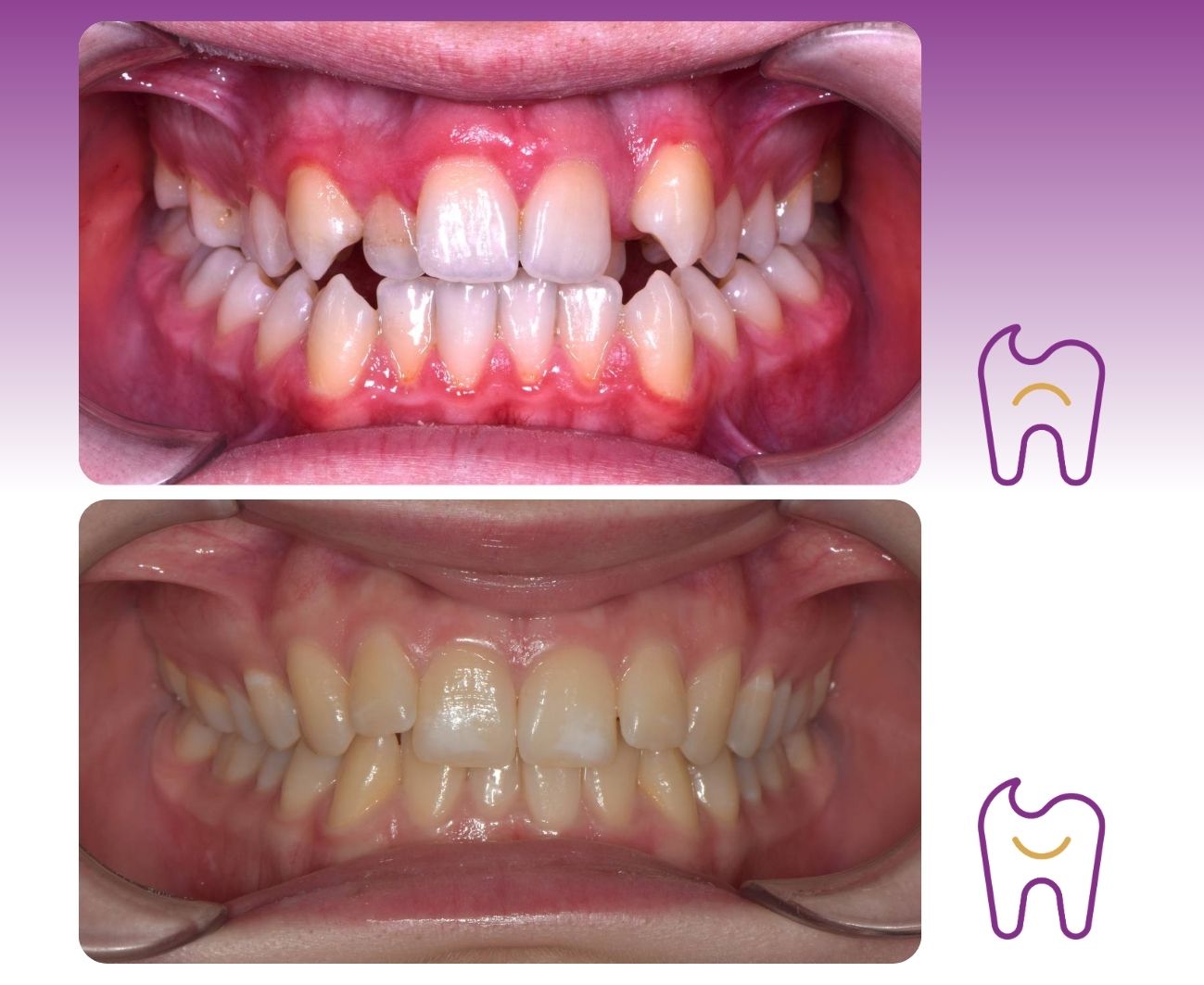
Our Work – Before & After

Our Work – Before & After

Orthodontic treatment
    Orthodontic treatment

      Types of braces we offer

      Types of braces we offer

      Invisible aligners (e.g., Invisalign or Spark)

      Invisible aligners (e.g., Invisalign or Spark)

      Suitable for children and adults, almost invisible, comfortable, with the possibility of monitoring treatment via a mobile application.

      Suitable for children and adults, almost invisible, comfortable, with the possibility of monitoring treatment via a mobile application.

      Fixed metal braces

      Fixed metal braces

      A classic and affordable solution for orthodontic problems.

      A classic and affordable solution for orthodontic problems.

      Ceramic (esthetic) braces

      Ceramic (esthetic) braces

      More discreet than metal braces, suitable for work or school.

      More discreet than metal braces, suitable for work or school.

      Retention appliances

      Retention appliances

      Stabilize the result after braces removal.

      Stabilize the result after braces removal.

      Our Work – Before & After

      Our Work – Before & After

      Orthodontic treatment
        Orthodontic treatment

          Types of braces we offer

          Types of braces we offer

          Invisible aligners (e.g., Invisalign or Spark)

          Invisible aligners (e.g., Invisalign or Spark)

          Suitable for children and adults, almost invisible, comfortable, with the possibility of monitoring treatment via a mobile application.

          Suitable for children and adults, almost invisible, comfortable, with the possibility of monitoring treatment via a mobile application.

          Fixed metal braces

          Fixed metal braces

          A classic and affordable solution for orthodontic problems.

          A classic and affordable solution for orthodontic problems.

          Ceramic (esthetic) braces

          Ceramic (esthetic) braces

          More discreet than metal braces, suitable for work or school.

          More discreet than metal braces, suitable for work or school.

          Retention appliances

          Retention appliances

          Stabilize the result after braces removal.

          Stabilize the result after braces removal.

          Guarantee

          Guarantee

          A guarantee of quality and pain-free treatment
          Top-tier equipment

          Top-tier equipment

          Advanced equipment for superior care
          Comprehensive Care

          Comprehensive Care

          Comprehensive care for our patients

          Opening Hours

          Opening Hours

          Extended opening hours including Saturdays

          Contracts

          Contracts

          Contracts with health insurance providers
          Dental laboratory

          Dental laboratory

          Our own modern dental laboratory

          Location

          Location

          Excellent transport accessibility

          Reception Services

          Reception Services

          A pleasant and calm environment
          Languages

          Languages

          We speak more than five languages
          Availability

          Availability

          We have short waiting times for appointments

          Our team

          Dentist
          Accepting patients
          CSUKENRU

          Why choose us?

          Why choose us?

          Customized treatment – based on a scan of your teeth and an X-ray, we will design the most suitable type of braces.
          Customized treatment – based on a scan of your teeth and an X-ray, we will design the most suitable type of braces.
          We have been dedicated to orthodontics for many years – our team includes certified orthodontists with extensive experience.
          We have been dedicated to orthodontics for many years – our team includes certified orthodontists with extensive experience.
          State-of-the-art technology – we offer treatment using 3D planning, digital scanning and mobile monitoring of the treatment progress.
          State-of-the-art technology – we offer treatment using 3D planning, digital scanning and mobile monitoring of the treatment progress.
          We treat children and adults – orthodontics is not about age, but about the correct position of teeth and quality of life.
          We treat children and adults – orthodontics is not about age, but about the correct position of teeth and quality of life.
          Aesthetic result and healthy teeth – straight teeth are not only about appearance, but also about better hygiene, chewing and articulation.
          Aesthetic result and healthy teeth – straight teeth are not only about appearance, but also about better hygiene, chewing and articulation.

          How much does orthodontic treatment cost?

          How much does orthodontic treatment cost?

          The cost of orthodontic treatment depends on the chosen type of braces, duration of wear and complexity of the orthodontic problem. We guarantee transparent and final prices – without hidden fees. For example:

          The cost of orthodontic treatment depends on the chosen type of braces, duration of wear and complexity of the orthodontic problem. We guarantee transparent and final prices – without hidden fees. For example:

          Invisible aligners: from 28990 Kč.
          Invisible aligners: from 28990 Kč.
          Fixed braces: from 27900 Kč.
          Fixed braces: from 27900 Kč.
          Retention and check-ups: included in the treatment plan.
          Retention and check-ups: included in the treatment plan.

          Why choose us?

          Why choose us?

          Customized treatment – based on a scan of your teeth and an X-ray, we will design the most suitable type of braces.
          Customized treatment – based on a scan of your teeth and an X-ray, we will design the most suitable type of braces.
          We have been dedicated to orthodontics for many years – our team includes certified orthodontists with extensive experience.
          We have been dedicated to orthodontics for many years – our team includes certified orthodontists with extensive experience.
          State-of-the-art technology – we offer treatment using 3D planning, digital scanning and mobile monitoring of the treatment progress.
          State-of-the-art technology – we offer treatment using 3D planning, digital scanning and mobile monitoring of the treatment progress.
          We treat children and adults – orthodontics is not about age, but about the correct position of teeth and quality of life.
          We treat children and adults – orthodontics is not about age, but about the correct position of teeth and quality of life.
          Aesthetic result and healthy teeth – straight teeth are not only about appearance, but also about better hygiene, chewing and articulation.
          Aesthetic result and healthy teeth – straight teeth are not only about appearance, but also about better hygiene, chewing and articulation.

          How much does orthodontic treatment cost?

          How much does orthodontic treatment cost?

          The cost of orthodontic treatment depends on the chosen type of braces, duration of wear and complexity of the orthodontic problem. We guarantee transparent and final prices – without hidden fees. For example:

          The cost of orthodontic treatment depends on the chosen type of braces, duration of wear and complexity of the orthodontic problem. We guarantee transparent and final prices – without hidden fees. For example:

          Invisible aligners: from 28990 Kč.
          Invisible aligners: from 28990 Kč.
          Fixed braces: from 27900 Kč.
          Fixed braces: from 27900 Kč.
          Retention and check-ups: included in the treatment plan.
          Retention and check-ups: included in the treatment plan.

          Orthodontic services price list

          Orthodontic services price list

          Valid from:
          ProcedureDetailsPrice
          Metal fixed appliancefrom 27900 Kč
          Spark invisible alignersfrom 28990 Kč
          Fixed Braces Hyraxfrom 17900 Kč
          Plate Scannerfrom 8990 Kč
          (*) price including 21% VAT

          Indications and contraindications for orthodontic treatment

          Indications and contraindications for orthodontic treatment

          The goal of orthodontic treatment is to align teeth into the correct position, optimize bite and improve overall health and aesthetics of the smile. Although orthodontics is suitable for a wide range of patients, there are situations where treatment is particularly recommended, and when caution or postponement is necessary.

          Indications (When is orthodontic treatment appropriate?)

          1. Dental anomalies (malocclusion)

          Crooked, crowded or spaced teeth that negatively affect aesthetics and function.

          2. Incorrect bite (malocclusion)

          Overbite, underbite, open bite, crossbite, deep bite, which can cause functional problems, tooth wear and temporomandibular joint issues.

          3. Problems with speech or chewing

          Some orthodontic anomalies can affect phonetics and chewing efficiency.

          4. Aesthetic requirements

          The desire for a straight and beautiful smile that boosts the patient’s confidence.

          5. Prevention and improvement of oral health

          Straight teeth are easier to clean, reducing the risk of tooth decay and periodontitis.

          6. Preparation before prosthetic treatment

          Moving teeth to create space for crowns, bridges or implants, resulting in a more stable and aesthetic outcome.

          7. Problems with mouth breathing

          In children, certain orthodontic problems may be related to mouth breathing, which affects facial and airway development.

          8. Facial asymmetry

          Improving facial symmetry, especially in growing children.

          Stopping and preventing tooth wear

          Malocclusion can lead to abnormal wear of the tooth surfaces.

          10. Temporomandibular joint disorders (TMD)

          Sometimes orthodontic treatment can help alleviate the symptoms of TMD.

          Contraindications (When is caution needed?)

          1. Untreated periodontitis

          Active and untreated inflammation of the gums or tooth supporting apparatus – moving teeth in inflamed bone is contraindicated and can worsen the condition.

          2. Insufficient oral hygiene

          A patient who is unable or unwilling to maintain a high level of oral hygiene. Braces make cleaning more difficult and poor hygiene leads to cavities and gum inflammation.

          3. Acute and untreated tooth decay

          All teeth must be cavity-free and gums healthy before starting orthodontic treatment.

          4. Untreated temporomandibular joint disorders (TMD)

          Acute painful conditions of the temporomandibular joints – require diagnosis and treatment of these problems first.

          5. Uncontrolled severe systemic diseases

          Very unstable diabetes, uncontrolled bleeding disorder, severe heart defects, immunodeficiency states – all of these conditions can affect the course of treatment and healing.

          6. Pregnancy

          Although braces themselves are not a contraindication, gums may become more sensitive during pregnancy and hormones can affect tooth movement. X-rays are strictly limited during pregnancy.

          7. Certain neurological disorders

          For example, uncontrolled epilepsy, which could endanger the patient or staff during a seizure.

          8. Unrealistic patient expectations

          If the patient expects results that are not medically or technically achievable.

          9. Extreme dental phobia/anxiety

          If the anxiety is so severe that it prevents regular check-ups and cooperation.

          10. Severe smoking

          Smoking negatively affects gum health and can complicate the treatment process, especially with more advanced methods.

          Important note: This list is general and indicative. Each case is unique and requires careful individual assessment by an orthodontist. Many of the relative contraindications can be successfully managed or avoided with appropriate preparation and interdisciplinary cooperation. It is always crucial to inform your orthodontist of your complete medical history and current health status so that they can choose the safest and most effective treatment plan.

          Indications and contraindications for orthodontic treatment

          Indications and contraindications for orthodontic treatment

          The goal of orthodontic treatment is to align teeth into the correct position, optimize bite and improve overall health and aesthetics of the smile. Although orthodontics is suitable for a wide range of patients, there are situations where treatment is particularly recommended, and when caution or postponement is necessary.

          Indications (When is orthodontic treatment appropriate?)

          1. Dental anomalies (malocclusion)

          Crooked, crowded or spaced teeth that negatively affect aesthetics and function.

          2. Incorrect bite (malocclusion)

          Overbite, underbite, open bite, crossbite, deep bite, which can cause functional problems, tooth wear and temporomandibular joint issues.

          3. Problems with speech or chewing

          Some orthodontic anomalies can affect phonetics and chewing efficiency.

          4. Aesthetic requirements

          The desire for a straight and beautiful smile that boosts the patient’s confidence.

          5. Prevention and improvement of oral health

          Straight teeth are easier to clean, reducing the risk of tooth decay and periodontitis.

          6. Preparation before prosthetic treatment

          Moving teeth to create space for crowns, bridges or implants, resulting in a more stable and aesthetic outcome.

          7. Problems with mouth breathing

          In children, certain orthodontic problems may be related to mouth breathing, which affects facial and airway development.

          8. Facial asymmetry

          Improving facial symmetry, especially in growing children.

          Stopping and preventing tooth wear

          Malocclusion can lead to abnormal wear of the tooth surfaces.

          10. Temporomandibular joint disorders (TMD)

          Sometimes orthodontic treatment can help alleviate the symptoms of TMD.

          Contraindications (When is caution needed?)

          1. Untreated periodontitis

          Active and untreated inflammation of the gums or tooth supporting apparatus – moving teeth in inflamed bone is contraindicated and can worsen the condition.

          2. Insufficient oral hygiene

          A patient who is unable or unwilling to maintain a high level of oral hygiene. Braces make cleaning more difficult and poor hygiene leads to cavities and gum inflammation.

          3. Acute and untreated tooth decay

          All teeth must be cavity-free and gums healthy before starting orthodontic treatment.

          4. Untreated temporomandibular joint disorders (TMD)

          Acute painful conditions of the temporomandibular joints – require diagnosis and treatment of these problems first.

          5. Uncontrolled severe systemic diseases

          Very unstable diabetes, uncontrolled bleeding disorder, severe heart defects, immunodeficiency states – all of these conditions can affect the course of treatment and healing.

          6. Pregnancy

          Although braces themselves are not a contraindication, gums may become more sensitive during pregnancy and hormones can affect tooth movement. X-rays are strictly limited during pregnancy.

          7. Certain neurological disorders

          For example, uncontrolled epilepsy, which could endanger the patient or staff during a seizure.

          8. Unrealistic patient expectations

          If the patient expects results that are not medically or technically achievable.

          9. Extreme dental phobia/anxiety

          If the anxiety is so severe that it prevents regular check-ups and cooperation.

          10. Severe smoking

          Smoking negatively affects gum health and can complicate the treatment process, especially with more advanced methods.

          Important note: This list is general and indicative. Each case is unique and requires careful individual assessment by an orthodontist. Many of the relative contraindications can be successfully managed or avoided with appropriate preparation and interdisciplinary cooperation. It is always crucial to inform your orthodontist of your complete medical history and current health status so that they can choose the safest and most effective treatment plan.

          Orthodontics FAQ

          Orthodontics FAQ

          On this page of our dental practice website, we have prepared answers to the most frequently asked questions from our patients. If you cannot find what you are looking for here, please do not hesitate to contact us.

          On this page of our dental practice website, we have prepared answers to the most frequently asked questions from our patients. If you cannot find what you are looking for here, please do not hesitate to contact us.

          Who is orthodontic treatment suitable for?

          Treatment is suitable for both children and adults – it depends on the specific dental malocclusion, condition of teeth and gums.

          Is it possible to wear invisible braces as an adult?

          Yes. Invisible braces (e.g., Invisalign) are very popular among adults due to their aesthetic appearance and comfort.

          How long does orthodontic treatment last?

          Usually 12-24 months, depending on the type of malocclusion. The length of treatment is individual and will always be determined by the doctor based on examination.

          Does getting braces hurt?

          Getting braces doesn’t hurt, but you may feel some pressure during the first few days. However, your body will quickly get used to it.

          How often do I need to come for check-ups?

          Usually every 6-8 weeks. The interval may be longer with invisible braces with monitoring.

          What if my oral hygiene isn’t perfect?

          We recommend professional dental hygiene before treatment. During treatment, oral hygiene is crucial for the health of your teeth and gums.

          Can I eat anything with braces?

          With fixed braces, it is recommended to avoid hard and sticky foods. Invisible braces are removed during meals.

          How to get started?

          Book an appointment online for a non-binding consultation. We will perform an examination, explain the treatment options and prepare an individual plan.

          Orthodontics FAQ

          Orthodontics FAQ

          On this page of our dental practice website, we have prepared answers to the most frequently asked questions from our patients. If you cannot find what you are looking for here, please do not hesitate to contact us.

          On this page of our dental practice website, we have prepared answers to the most frequently asked questions from our patients. If you cannot find what you are looking for here, please do not hesitate to contact us.

          Who is orthodontic treatment suitable for?

          Treatment is suitable for both children and adults – it depends on the specific dental malocclusion, condition of teeth and gums.

          Is it possible to wear invisible braces as an adult?

          Yes. Invisible braces (e.g., Invisalign) are very popular among adults due to their aesthetic appearance and comfort.

          How long does orthodontic treatment last?

          Usually 12-24 months, depending on the type of malocclusion. The length of treatment is individual and will always be determined by the doctor based on examination.

          Does getting braces hurt?

          Getting braces doesn’t hurt, but you may feel some pressure during the first few days. However, your body will quickly get used to it.

          How often do I need to come for check-ups?

          Usually every 6-8 weeks. The interval may be longer with invisible braces with monitoring.

          What if my oral hygiene isn’t perfect?

          We recommend professional dental hygiene before treatment. During treatment, oral hygiene is crucial for the health of your teeth and gums.

          Can I eat anything with braces?

          With fixed braces, it is recommended to avoid hard and sticky foods. Invisible braces are removed during meals.

          How to get started?

          Book an appointment online for a non-binding consultation. We will perform an examination, explain the treatment options and prepare an individual plan.

          Hodnocení Smile Centrum

          Doporučuje nás 92% našich pacientů, kteří zanechávají recenze na nezávislých portálech a sociálních sítích. Klinika je nemůže
          ovlivnit, a proto jsou pro nás tak cenné.

          Google
          4,9

          ★★★★★

          Seznam
          4,9

          ★★★★★

          WhatClinic
          5,0

          ★★★★★

          Bookimed
          5,0

          ★★★★★

          Google
          4,9

          ★★★★★

          Seznam
          4,9

          ★★★★★

          WhatClinic
          5,0

          ★★★★★

          Bookimed
          5,0

          ★★★★★